
You're Probably Underconsuming Protein
Attempting to Become an "Expert" With AI: Part 2

This follows Attempting to Become an “Expert” With AI: Part 1. Sharing my capstone project: a write-up of what I learned, with the application of those learnings into a tool.
Neither this post nor the calculator should be used as a definitive guide for your recommended protein intake. It also doesn’t cover chronic conditions or illnesses, which requires actual medical advice. Please make sure to consult your doctors and dietitians.
The question that started this whole side quest: “why are you targeting these macros?”
Turns out that question is more loaded than it sounds. Especially when it’s from the R&D and food science big brain you’re working with, who spent 20 years at Coca-Cola creating things like... protein shakes. And since I cherish this new partnership and want to be a ✨ value-add collaborator ✨, I decided to teach myself everything I can about protein in 14 days so that I can come to our working sessions with a more thoughtful toolkit.
Your Protein Target is a Formula, Not a Flat Number
If your protein targets have been determined by a random headline you saw that said you only need 50g of protein a day or 1g of protein per body weight, you’re not alone.
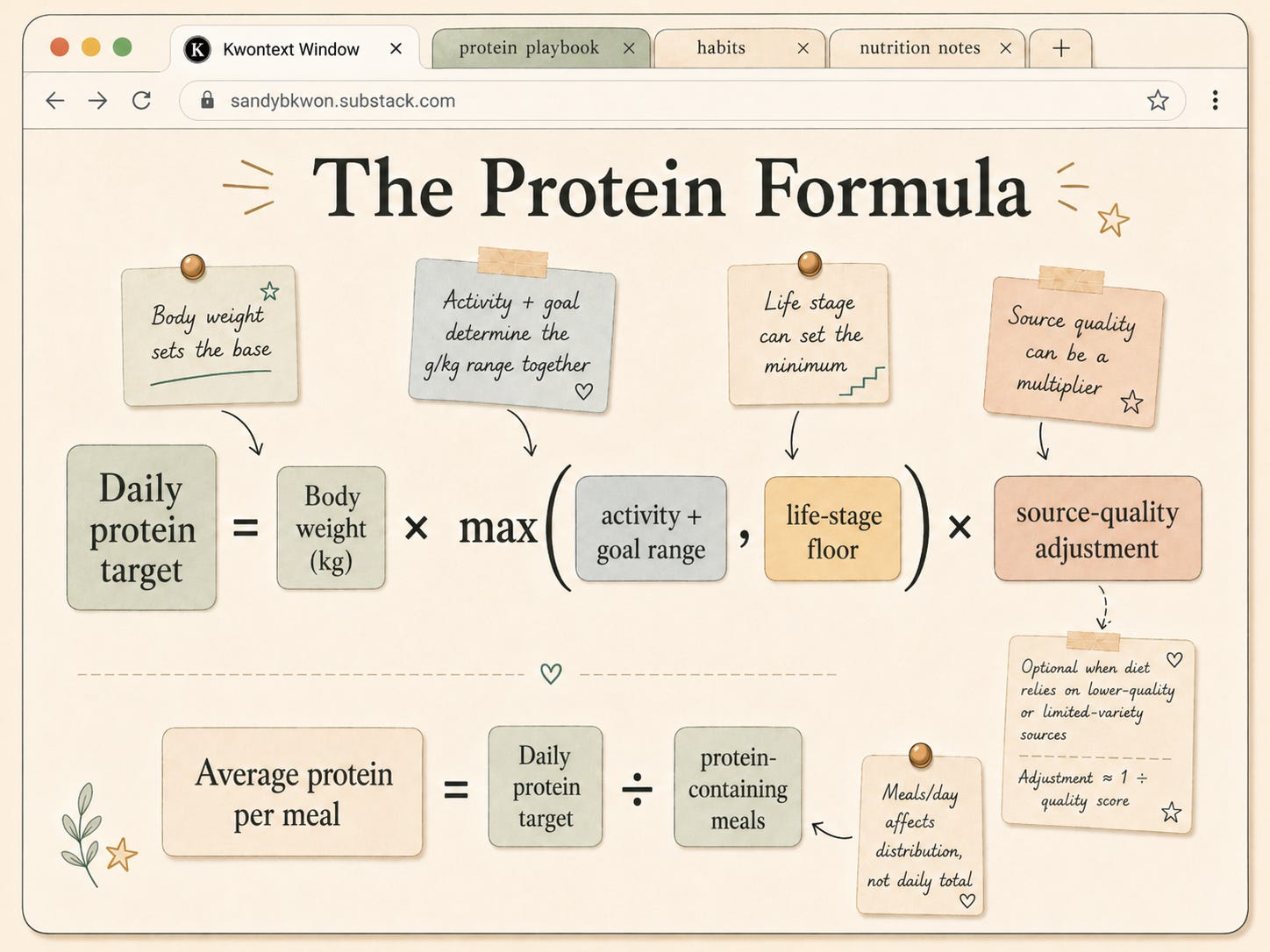
Turns out, the amount of protein you should ingest is a formula, and lucky for you, you only need to know PEMDAS to calculate it! These are the key inputs:
Body weight - the baseline.
Pregnancy, breastfeeding, or menopause status - pregnancy and breastfeeding set a hard floor, menopause nudges you toward the upper end of your range.
Age - adjusts the baseline.
Activity level - adjusts baseline.
Your goal: maintain, build muscle, cut, or endurance - adjusts baseline.
Your protein source, and whether you’re combining sources - adjusts recommended amount.
How many meals you’re spreading your intake across - helps you calculate how much you should consume per meal.
Breaking down each component of the Protein formula
Body weight
Body weight sets the baseline and is the main driver of your number. Every protein guideline in the research, from the basic Recommended Dietary Allowance (RDA) to the athlete ranges, is expressed as grams per kilogram of body weight. Everything below scales off this.
Pregnancy, breastfeeding, and menopause
Women’s bodies require more protein based on what they’re creating or sustaining in a given season of life. A body growing another person or making milk for one is doing more than a body just maintaining itself, and the numbers below reflect that.
Pregnancy raises the floor to about 1.1g/kg because you’re building an entire additional person on top of yourself.
Breastfeeding raises it further to about 1.3g/kg because producing milk has its own real metabolic demand on top of everything else your body is already doing.
Menopause research shows a blunted muscle-building response to protein after menopause (tied to declining estrogen), but the evidence is mixed and a 2026 review found it isn’t settled enough yet to support a hard new floor. So instead of jumping to a new tier, aim toward the upper end of your normal range if this applies to you, especially alongside resistance training.
Before we move on, can we just take a moment to acknowledge how incredible women’s bodies are? Okay, next...
Age
As we age, our bodies become less efficient at using the protein we eat due to something researchers call anabolic resistance. Aging muscle needs a bigger dose to trigger the same muscle-building response. Less blood flow delivers amino acids to muscle less efficiently, more of what you digest gets used by the gut and liver before it ever reaches muscle, and the signaling pathway that recognizes that amino acids are available to build muscle gets desensitized over time. The PROT-AGE study group’s geriatric nutrition guidance recommends at least 1.0-1.2g/kg for healthy adults 65+ regardless of activity level, with a higher range of 1.2-1.5g/kg for anyone managing an acute or chronic illness.
Activity level and goal
How much you move and what you’re trying to do with your body work together as one factor.
Start with your baseline activity level to find your target range:
The RDA: 0.8g/kg, the previous reference for nearly all healthy adults.
The newer 2025 federal guidelines: 1.2-1.6g/kg.
Sports-nutrition guidance: 1.4-2.0g/kg, for people who exercise regularly.
Elite or physique-focused training: up to 2.2g/kg.
Then adjust for goals:
Maintaining or training for endurance: no adjustment.
Building muscle: add about 0.1g/kg on top.
Cutting calories while trying to hold onto muscle: add about 0.2g/kg on top, your body needs a stronger signal to protect muscle while you’re cutting.
Quick note on GLP-1 medications, since they’re a big reason protein’s suddenly everywhere: according to a 2024 meta-analysis, people on these drugs lose roughly 25% of their weight as lean mass (which muscle is one part of), not just fat. I’m not an authority on the full clinical picture, but functionally that puts GLP-1 users in the same bucket as someone cutting calories while trying to hold onto muscle. GLP-1 users should prioritize preserving muscle by increasing protein intake, while incorporating resistance training.
Protein source and quality
A few terms worth covering before we continue:
EAAs (essential amino acids): the 9 amino acids your body can’t make on its own and that you can only get from food.
Complete protein: a source that supplies all 9 EAAs in the amounts your body needs. More on that below.
PDCAAS (Protein Digestibility-Corrected Amino Acid Score): It checks a protein’s weakest EAA against how much you need, then adjusts for digestibility by reading your stool. This is an outdated way of measuring protein quality, but the US nutrition labels still use this method to publish claims like “excellent source of protein.”
DIAAS (Digestible Indispensable Amino Acid Score): Recommended by the FAO in 2013 to replace PDCAAS, but not yet used on US labels. It measures digestibility earlier and more precisely (at the small intestine) and doesn’t cap high scores the way PDCAAS does.
When you read a nutrition label’s protein content, the real thing to evaluate is how much of that is usable protein. That breaks into two sub-questions: how much of it is complete (all 9 EAAs in the amounts you actually need), and how much of it is digestible (does your body actually absorb what’s there).
When a nutrition label says “20g of protein,” it means the food’s protein source has 3.2g of nitrogen. The FDA lets companies calculate the grams on a label by measuring nitrogen and multiplying by 6.25, because protein is roughly 16% nitrogen and there isn’t a way to measure protein directly. This calculation doesn’t cover which amino acids you’re getting or how much your body can actually use. Two products can both say “20g protein” and deliver very different usable amounts of protein.
What it means to be complete: Protein is a chain of amino acids, and the 9 EAAs only come from food. A protein is “complete” when it supplies all 9 in the amounts you need.
What it means to be digestible: Even a protein with all 9 EAAs can fall short if your body doesn’t actually absorb much of it. DIAAS scores this using the weakest amino acid. It checks how much of that specific amino acid your body actually absorbs, then scores the whole protein based on that. A 1.0 means it fully covers what your body needs.
Whey isolate scores around 1.0 to 1.09. Rice isolate scores around 0.42 because its weakest link (lysine) falls short. This just means that rice (on its own) delivers meaningfully less usable protein than its label number suggests.
This is a natural point to talk about vegan and vegetarian diets specifically. This exact completeness question is where a lot of outdated advice about protein combining comes from...
The Academy of Nutrition and Dietetics’ position on vegetarian and vegan diets: “an assortment of plant foods eaten over the course of a day can provide all essential amino acids; thus, complementary proteins do not need to be eaten at the same meal.”
To put this plainly: if you drink pea protein, which is short on sulfur amino acids, you don’t have to pair it with rice or another sulfur-rich source right away. Amino acids get absorbed in your small intestine over several hours after a meal, and everything you eat throughout the day pools together in your bloodstream. So it’s important to remember to aim for variety across the day if you aren’t consciously pairing complementary proteins at every meal. That said, if you’re exclusively eating pea protein, then you’re consistently low in one EAA and each gram of protein is doing less work for your body.
You might have noticed that pea protein powder almost always comes blended with rice protein. It’s because pea is short on sulfur amino acids and rice is short on lysine, so blending the two balances the profile in one scoop. That means every gram in that serving is immediately useful, instead of your body needing extra pea protein to make up for what it’s missing on its own.
If you just need a quick reference sheet, here’s the profile for common sources and what actually closes the gap if there is one:
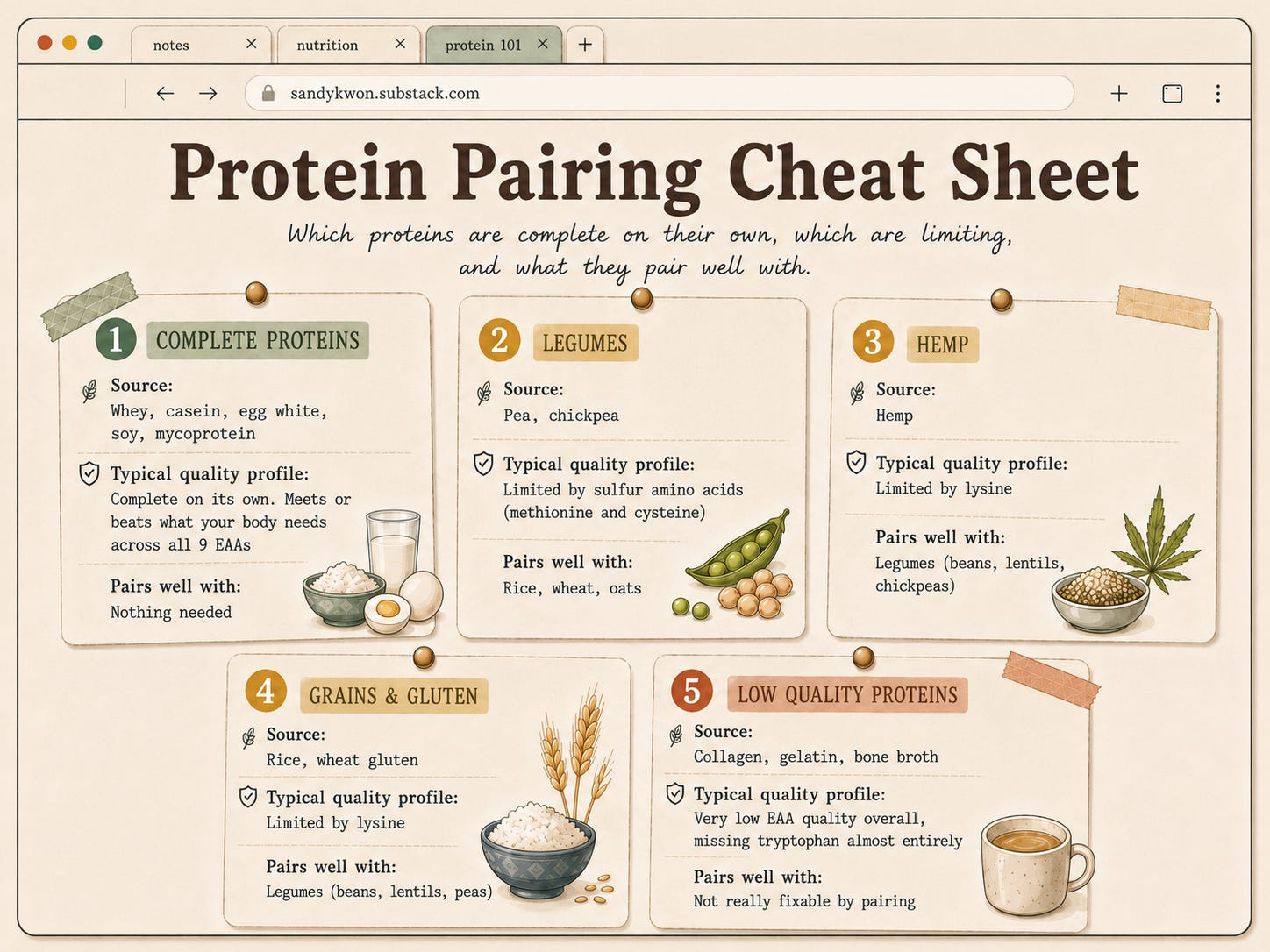
BTW — Collagen’s having a moment in bars and powders partly because it’s cheaper than whey. It’s missing tryptophan almost entirely though, so it can’t work as a standalone complete protein for muscle development. That said, if your goal is bouncy skin and strong joints, it’s still doing real work, just through a different mechanism.
Meals per day
There’s a lot of debate in health and fitness circles about how much protein your body can actually use in one sitting. If your goal is to trigger muscle protein synthesis, there’s a per-meal amount that ensures it. Research puts that at 0.25-0.4g/kg, roughly 20-40g/meal for most people. Eating more than that in one sitting shows diminishing returns in the research, not a hard ceiling. Take your daily target and divide by however many meals you eat to see where you land: under that range and each meal’s giving you a weaker version of the signal, even if the daily total is adequate.
What’s the tl;dr ?
The tl;dr is that I built a calculator to incorporate all of this information to help you determine the exact amount of protein you might need per day, per meal, based on everything I shared above.
If you’ve read this far, thank you for being a part of this journey! This is my best effort based on what I learned, using the program I designed to become an “Expert” in 14 days. I’m sure there might be some misrepresented claims here, and I’m still actively learning, so please share anything that fills a gap or corrects an error in my understanding.
ooxxooXoXXx,
SK